Pay in installments of $6.22 with
 ,
,
 and
and

Shipping Estimate
USA
- USA
- CAN
- USA
- CAN
Ships within 48 hours · Estimated delivery Jun 29 - Jul 4
 Promo Codes Available:
For Your Every Summer RSVP, with Code: SUMMER15
Description
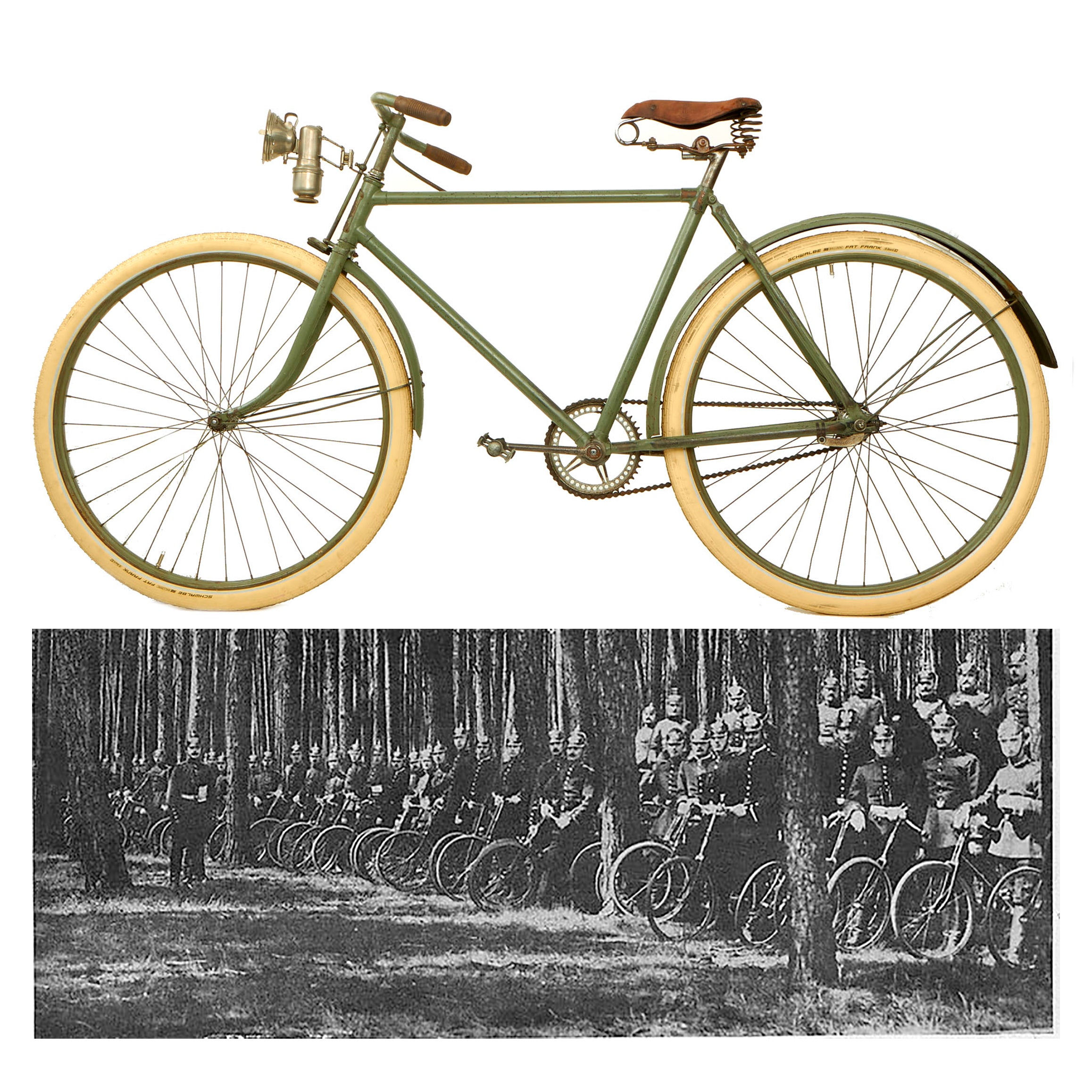
german fixed gear bike Original German WWI Model 40 Bicycle by Presto – International Military AntiquesOriginal Item: Only One Available. Fantastic rare wartime German bicycle! This example was produced by the Presto company, a German manufacturer of turn of the century bicycles and for the war effort during World War Two. The Germans needed to mobilize vast amounts of troops during WW1, and bicycles were used wherever possible. As you can see from these photos, the majority were not accessorized with military fittings like the British machines. With
Original Item: Only One Available. Fantastic rare wartime German bicycle! This example was produced by the Presto company, a German manufacturer of turn of the century bicycles and for the war effort during World War Two.
The Germans needed to mobilize vast amounts of troops during WW1, and bicycles were used wherever possible. As you can see from these photos, the majority were not accessorized with military fittings like the British machines. With much larger troop numbers, any available bicycle was used by the military.
Unlike the lightweight French bikes and middleweight British bikes, the normal style of civilian bicycle in Germany was a heavyweight roadster with front plunger brake and coaster rear hub, so they were ideally suited for military service. This example could very well have been used by the Imperial German Army, but without proof we are uncertain. We have found a picture online (not included) that shows military using the same or a very similar model.
The bicycle is in very good condition with areas of oxidation, paint loss and minor denting. Overall this is a sound example especially for its age. Tires and tubes are brand new and hold air perfectly, the rear foot brake operates and the hand front brake moves but needs adjustment to operate. The chain and main gear is solid and operational. We have even taken it for a test drive!
Comes ready for further research and display.
During World War I cycle-mounted infantry, scouts, messengers and ambulance carriers were extensively used by all combatants. Italy used bicycles with the Bersaglieri (light infantry units) until the end of the war. German Army Jäger (light infantry) battalions each had a bicycle company (Radfahr-Kompanie) at the outbreak of the war, and additional units were raised during the war, bringing the total to 80 companies. A number of these were formed into eight Radfahr-Bataillonen (bicycle battalions). The British Army had cyclist companies in its divisions, and later two whole divisions became cyclists: 1st and 2nd Cyclist Divisions.
Prior to the start of trench warfare the level terrain in Belgium was well used by military cyclists. Each of the four Belgian carabinier battalions included a company of cyclists, equipped with a brand of folding bicycle named the Belgica. A regimental cyclist school gave training in map reading, reconnaissance, reporting and the carrying of verbal messages. Attention was paid to the maintenance and repair of the machine itself.
In its 1937 invasion of China, Japan employed some 50,000 bicycle troops. Early in World War II their southern campaign through Malaya en route to capturing Singapore in 1941 was largely dependent on bicycle-riding soldiers. In both efforts bicycles allowed quiet and flexible transport of thousands of troops who were then able to surprise and confuse the defenders. Bicycles also made few demands on the Japanese war machine, needing neither trucks nor ships to transport them, nor precious petroleum. Although the Japanese were under orders not to embark for Malaya with bicycles, for fear of slowing up amphibious landings, they knew from intelligence that bicycles were plentiful in Malaya and moved to systematically confiscate bicycles from civilians and retailers as soon as they landed. Using bicycles, the Japanese troops were able to move faster than the withdrawing Allied Forces, often successfully cutting off their retreat. The speed of Japanese advance, usually along plantation roads, native paths and over improvised bridges, also caught Allied Forces defending the main roads and river crossings by surprise, by attacking them from the rear. However, there were one or two cases of Australian troops turning the tables on the Japanese by isolating cycle troops from their accompanying motorized forces after blowing up bridges over rivers.
During the Invasion of Poland of 1939, most Polish infantry divisions included a company of bicycle-riding scouts. The equipment of each bicycle company included 196 bicycles, one motorcycle with sidecar, and nine horse-drawn supply carts, plus three to six anti-tank rifles and standard infantry equipment such as machine guns, rifles, pistols, and hand grenades.
The Finnish Army utilized bicycles extensively during the Continuation War and Lapland War. Bicycles were used as a means of transportation in Jaeger Battalions, divisional Light Detachments and regimental organic Jaeger Companies. Bicycle units spearheaded the advances of 1941 against the Soviet Union. Especially successful was the 1st Jaeger Brigade which was reinforced with a tank battalion and an anti-tank battalion, providing rapid movement through limited road network. During winter time these units, like the rest of the infantry, switched to skis. Within 1942–1944 bicycles were also added to regimental equipment pools. During the Summer 1944 battles against the Soviet Union, bicycles provided quick mobility for reserves and counter-attacks. In Autumn 1944 bicycle troops of the Jaeger Brigade spearheaded the Finnish advance through Lapland against the Germans; tanks had to be left behind due to the German destruction of the Finnish road network.
The hastily assembled German Volksgrenadier divisions each had a battalion of bicycle infantry, to provide a mobile reserve.
Allied use of the bicycle in World War II was limited, but included supplying folding bicycles to paratroopers and to messengers behind friendly lines. The term "bomber bikes" came into use during this period, as US forces dropped bicycles out of planes to reach troops behind enemy lines.
By 1939, the Swedish Army operated six bicycle infantry regiments. They were equipped with domestically produced Swedish military bicycles. Most common was the m/42, an upright, one-speed roadster produced by several large Swedish bicycle manufacturers. These regiments were decommissioned between 1948 and 1952, and the bicycles remained for general use in the Army, or were transferred to the Home Guard. Beginning in the 1970s, the Army began to sell these as military surplus. They became very popular as cheap and low-maintenance transportation, especially among students. Responding to its popularity and limited supply, an unrelated company, Kronan, began to produce a modernized version of the m/42 in 1997.
Shipping Notes
- Free Standard Shipping on $100+ Orders to the USA.
- Except Preorder products are shipped in 48 hours.
- Delivery to the USA:
- Standard Shipping : 3-10 business days
- If time is of the essence, please consider selecting expedited delivery for faster service.
Exchange/Return Notes
- We offer a 30-day return/exchange service after receiving.
- Final sale items are not eligible for returns or exchanges.
- To process your return/exchange, please contact us at [email protected]
- Please click here for more details>>> Return & Exchange Policy